
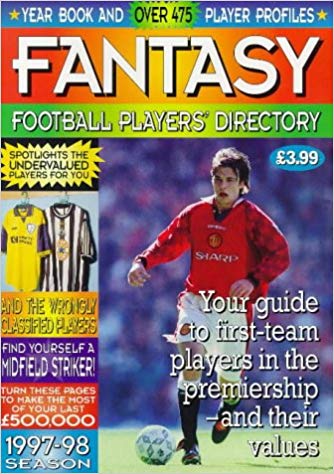
Football would never be the same for me this summer. Not only was the title “Premiership” replaced with “Premier” for the best football league in the world, but I stumbled across Fantasy Premier League. Immediately memories of being 12, going through the back a newspaper, while waiting in a corridor far to posh for the likes of me, for a Saturday morning piano lesson in Blackheath, I really had no intention of showing any signs of improvement in. No being the next Glen Hoddle (im a Chelsea fan) was my dream and Fantasy Football would be my Everest, my Definitely Maybe, my greatest achievement in life!
Before the internet Fantasy Football was a very different animal. You had to request a transfer via postage or phone a national newspaper (the one your dad brought home from work every day), and declare your team with pride, to an underachieved student stuck in the basement of a media giant, who wouldn’t even have the inclination or interest to question why I have chosen Shaka Hislop over Peter Schmeichel. Requesting a transfer was the same routine and it is little wonder why for many interest over the season diminished quickly.
Fast forward back to 2007. The birth of the internet, smartphones and social media may have been detrimental to certain aspects of society, but for Fantasy Football they had breathed new life into the game. Little was I to know that over the next thirteen years technology would be the catalyst to an industry that has now been officially endorsed, gone global and created internet fantasy football gurus to the status of Kim Kardashian or at the very least Jake Paul (I had to google him).
Pre-Season
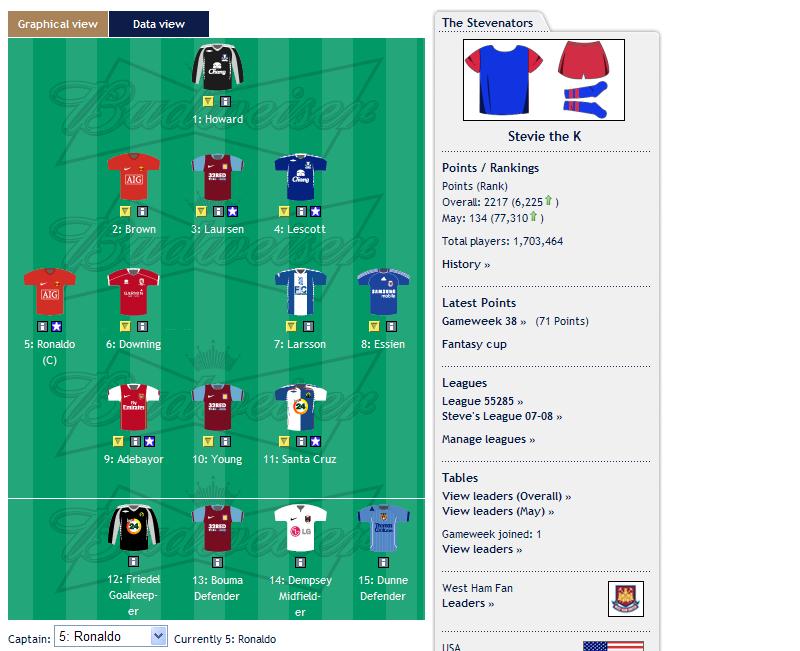
The previous 13 pre-seasons has taught and reaffirmed many lessons, if not mostly humility. I would like to think that any FPL “Expert” podcaster, analyst or member of the FPL Community would agree that they do not know how formulate the perfect GW1 team.
My approach to putting together a FF team for GW1 has always been flexible and reactive. Depending on the status of Premier League squads, in regards to how settled they are and how they performed the previous season, I have either selected two or three players and none if a club is in a period of transition or had an erratic previous season. This may seem like common sense, but there are FPL managers who have a system and stick to it, “Pulis Players” if you like. I would recommend a more flexible “Sven System” of looking at what you have got and how best to get through the first four game weeks at the very least (although playing Beckham in a Quarterback role was a step too far for me).
This pre-season is definitely one of the hardest to decipher, as with the exception of Manchester City, Liverpool and Tottenham the rest of the most popular teams are in a state of flux. There are also a number of teams like Everton, Wolverhampton, Watford, Bournemouth that have favourable starts to their Premier League campaign. An appealing run of fixtures is always going to attract the attention of FPL managers, however as it has been seen before, they can be misleading especially during the opening fixtures when clubs are getting settled into the season.
A perfect example of this is last season was Southampton, when the majority of the FPL Community on social media was singing lyrically about their favourable early fixtures. This resulted in many FPL managers selecting 2 or 3 Saints players, with a very disappointing outcome. The result of which made for a lot of difficult decisions for these managers. Issues such as whether to stick or twist with their Southampton selections, as other FPL managers began to panic and remove them from their squads. This was resulting in the individual player values and FPL team values dropping, if other managers did not react quick enough, resulting in a snowball effect in player values even further.
At such an early stage a 0.1 drop in team value is more like a 0.5 drop, as FPL managers would only be able to transfer in players that are 0.5 less than the original Southampton player transfer. This loss would only ever be recovered if the manager sold a player that rose to the same value. This introduces the subject of Team Values and their importance, which can be covered later. It was also using valuable Free Transfers, which otherwise could have been used for other problem areas of their squads. This in turn brought the conundrum of whether to take hits early on in the season. This is a prime example of how heavily backing a single team can have a knock on effect of problems, if it all goes wrong.
Bandwagons
Last season the popularity for Southampton at the beginning of the season highlighted the potential danger of Bandwagons. When deciding whether or not to follow a bandwagon (which can feel like the opinion of everybody), it is important to consider how a bandwagon is formed and why it is not always as popular as it can seem.
It is human nature for people to surround themselves with others of a similar personality, taste or opinion. This is how political parties and movements are formed. Social media has allowed people of a similar ilk to communicate and support each other’s ideas and opinions. In the FPL Community there is no better confidence builder for your posted draft on Twitter, when a similar opinion on a particular tactic or strategy is found. These FPL managers can support each other as they go forward with their squads and theories, to ease their concerns regarding their own squads and reassuring the rest of the heard. Suddenly the theory spreads, people feel they could miss out on points that the FPL Community massive will receive and don’t want to be left behind. Suddenly an Indiana Jones Temple Of Doom boulder is rolling through Twitter, collecting FPL managers as it crashes through.
Last season there was a fair amount of complaining from the FPL Community that the so called “Casuals” were doing well, that it was a “Casual Season” as the “obvious players” were scoring well and consistently. As a result some bandwagons were struggling to justify themselves, as often bandwagons are based on a theory slightly left of centre, giving the impression that the FPL Community know something that the remaining mangers do not. I stayed away from the Twitter consensus of backing Southampton last season. It paid off, but it could of easily been a disaster if the Saints had hit the ground running.
This year, the current trend going through the FPL Community is to “go big at the back”. The theory that safer, more consistent points can be collect through defenders from Liverpool and Manchester City and to a lesser degree Everton and perhaps Chelsea.
Last season’s statistics defend this theory, encouraging FPL managers to select two or even three defenders from Liverpool or Manchester City, at the expense of typically higher priced midfielders and forwards. It is a theory all FPL Podcasters are discussing and in favour of and is turning into this season’s Bandwagon that shows no sign of stopping.
I have not seen any negative comments regarding the popularity for an expensive defence, but I believe there is one detrimental aspect to this strategy. By placing a high percentage of the budget into defenders, there is obviously less to spend on a number of higher valued midfielders and forwards. The average draft at the moment, following this practice is acquiring 2 high priced midfielders and no big hitting forwards or one of each.
Now it has often been claimed that placing the captains armband on a defender is a waste, as there is less of a chance of a defender accumulating a big score, as often the most you can hope for is a clean sheet and perhaps an assist also. In comparison with attacking midfields or forwards who have the potential to score a brace of goals, assists or both. It would seem more likely to receive a double figure haul from an offensive player rather than a defensive player. By limiting the number of high valued attacking players in your squad, you reduce the realistic captaincy options at your disposal, of forward players. This may not be an issue for some managers who intend to stick and leave the armband on the likes of Salah or Sterling, however the option of at least a few players who have the potential of double figure hauls is never a bad situation to be in.
Ownership
Are the bandwagons justified? Well that is the opinion of the individual. The FPL Community is wide and varied but depending on what media an FPL manager uses, if at all any, then the intensity of a particular bandwagon they are subjected to can differ. The tidal wave created by bandwagons however, does affect all FPL managers and highlights the issue of player ownership.
I would always tell FPL managers that after all the discussion and analysis, they need to pick their squad on their terms. There is nothing worse in FPL when your select a player because you have allowed yourself to be talked or pressured into it and it turned out to be a mistake. There is however a caveat especially in the first few game weeks of FPL regarding ownership.
The level of ownership a player possesses is an important issue, especially for the beginning of the season. If you do not own a player with approximately 30% or higher ownership, who scores well in the opening fixtures, then you will find yourself at a massive disadvantage. If on the other hand, said player struggles and you are one of the masses who placed him in your side, then you have had to injure the pain collectively and your overall ranking may not suffer too harshly.
Im not condoning selecting players all season purely based on their ownership, but I believe it is an important criteria to give yourself the opportunity to stay in touch with the higher ranks, at the very early stages of the season. It is conservative and risk adverse and may not be as profitable as taking a punt on Arsenal, Bournemouth, Watford or Everton who may come out all guns blazing. Fortune often does favour the brave and Twitter is more than happy to show you posts of triple figure game week scores. You rarely hear the other side of the coin and I would rather still be in the fight, rather than knocked out in round one. Of course it is not possible to win or lose FPL after GW1 but a sound start lays a great foundation.
As well as the most popular players, it is important to take into account the other extreme. As budgets become tight, the vast majority of FPL managers will be looking for bench fodder and the odd enabler. Although I hope to have a full squad of regular starters, this is realistically not going to be the case and the game time for many 4.0 and 4.5 enablers and bench fodder being severely limited. As some managers panic that these players are not performing, the ownership of these players will fall and as a result the value has a risk of dropping. To mitigate this I often select bench fodder with the lowest ownership.
For example, as I write this Stekelenburg and Nketiah have an ownership of 5.1% and 4.8% respectively. If im using these positions as enablers and no expectations of them making my starting lineup, I would be selecting the likes of Norris and Gallagher with considerably lower ownership. The likely event of their value dropping from transfers out of squads is significantly less, as less managers own them at the start of the season.
This tactic is purely based on an attempt to protect my squad value at an early stage of the FPL season.
Tools Of The Trade
There is now an abundant supply of information and tools at the fingertips of FPL managers, depending on which websites they read and memberships they subscribe to. There are endless spreadsheets and algorithms on the internet, designed to help FPL mangers select their perfect squad. Fantasy Football is still certainly a game of opinions. If we all followed mathematical equations and probability formulas, we would all have the same team. I have studied these tables in previous seasons but not followed their output religiously for one simple reason. Statistics tell you what has definitely happened, not what will definitely happen.
We have 22 humans running around a football pitch, no Excel spreadsheet in the world could predict what will happen. The question is an individual’s faith in its accuracy of probability. The most useful spreadsheet I find is a simple fixture tracker, which just allows you to look in advance and prepare potential transfers for clubs who have a decent or terrible run of fixtures. There is a danger of trying to be too clever and looking too far ahead. I have found in the past what when struggling and playing catch up, simply looking a single game week at a time can prove profitable. I wouldn’t recommend it for a long period of time as you could easily find your squad staring at an unpleasant set of fixtures, with your bench providing little assistance.
I get no greater satisfaction in the world of FPL by going old school and selecting a player that caught my eye in during a live match, who may not of ticked the necessary boxes for an algorithm to select him as a potential addition to its subscriber’s squads.
I think it is important to take as much information on board as possible, without over indulging yourself and leaving you in knots. Take a bit of everything: a spreadsheet, a tracker, your experience, your gut and just go for it.
Summary
I know it has been said before, but at the end of the day pick the team you are genuinely comfortable with. Play the game to your style, throw caution to the wind and hope you leave everybody trailing in your wake. Play the steady Eddie approach and go for the long game, hoping you are still in the hunt come March, it is up to you. This game is very much a battle with yourself than other people.
Im certainly no expert at this game as the previous 13 years will testify. The game has got tougher as more people have started participating and it can certainly take over your life. With the issue of mental health rightly being discussed more in society (especially men’s), it is important to try and keep FPL in perspective. Have a passion for FPL, try and crack its enigma machine, solve its riddle as so many people consistently come so close to doing. Most of all enjoy yourself, have fun. It has brought a lot of people together with a harmless common interest. Whether or not you have a great season or a terrible one, to a certain degree your fantasy football team is in the hands of the FPL gods.
by Peter Ovington – @FPL_RubberDucky
Pages: 12
 Fantasy Football Club